
SHRED MOTO / Setup & clearance
Harley Cornering Clearance & Lean Angle
Raising footpegs by 1.5 inches moves your boots and peg tips higher, but real cornering clearance depends on the entire bottom profile of the bike: shocks, fork sag, exhaust routing, primary cover, and tires. Check what actually touches first before buying parts.
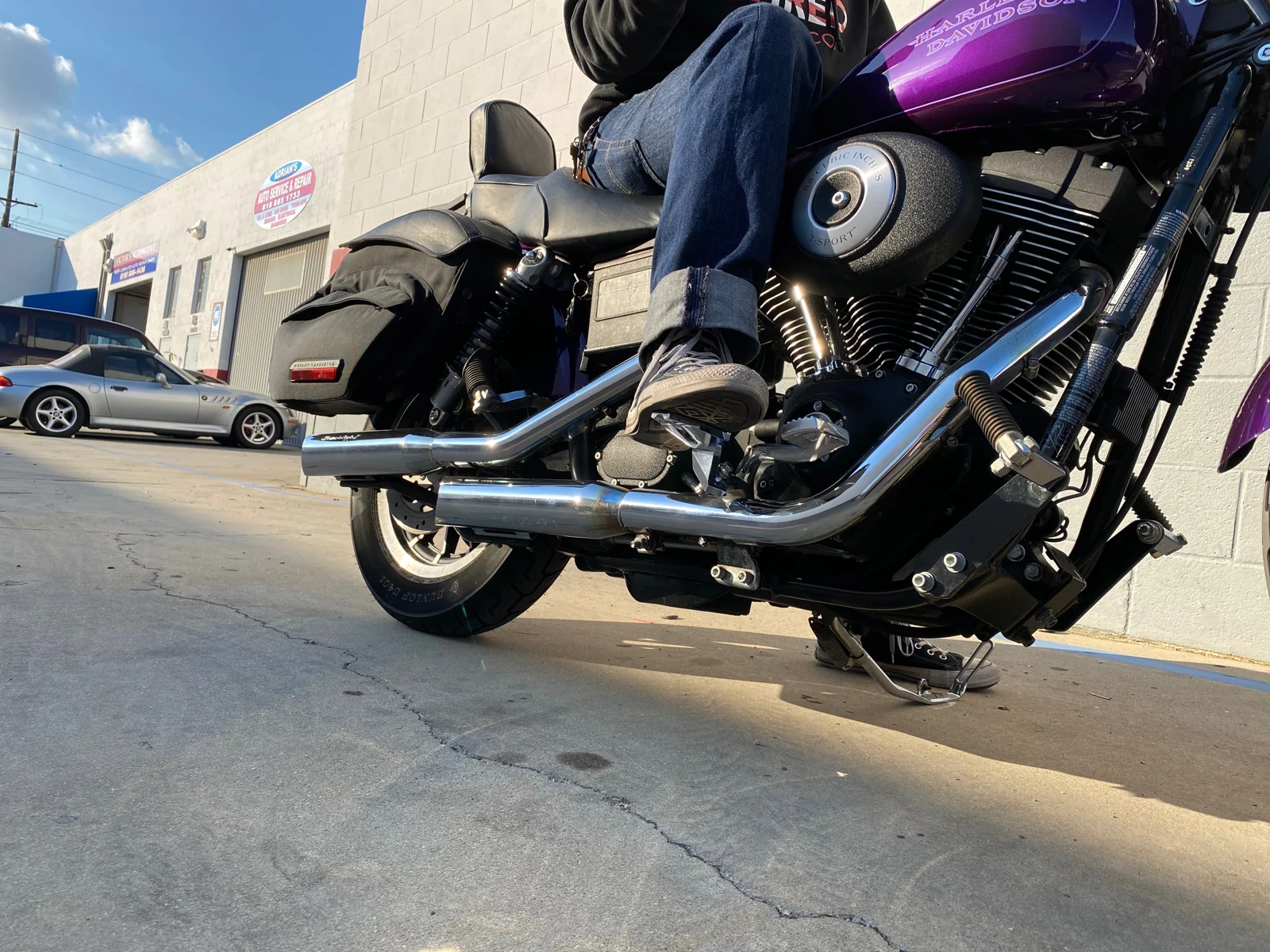
Find out what actually scrapes first on your bike
Riders often ask how to get more lean angle on a Harley Low Rider ST, Low Rider S, or Dyna, and jump straight to one part. Before ordering anything, put the bike on a clean floor or lift and inspect the scuff marks on both sides. On the right side, the culprit is usually the footpeg feeler, rear brake pedal, or lower 2-into-1 exhaust collector. On the left side, it is typically the footpeg, jiffy stand bracket, or outer primary edge.
Fixing only the peg while leaving a low-slung staggered pipe or worn, sagged rear shocks untouched simply shifts ground contact from a folding peg to a rigid part. Rigid contact is far more dangerous because it can unload the rear tire mid-corner.
| Component | Side affected | What happens when it touches | Inspection check before buying |
|---|---|---|---|
| Stock footpegs / feelers | Left & right | Folds up early and catches outer boot edge | Check mount family (2017-earlier Dyna/FXR vs 2018+ M8 Softail) |
| Rear shock / fork sag | Both sides | Chassis squats mid-corner and cuts ground clearance under load | Measure rider sag before changing ride height |
| 2-into-1 exhaust / heat shield | Right side | Rigid scrape that can lift the rear tire if pushed | Confirm upswept pipe clearance at full rear-shock compression |
| Primary cover / jiffy stand | Left side | Hard chassis contact on stock-height bikes | Inspect scuff marks under the primary and kickstand tang |
Balance chassis ride height with peg offset
Suspension height and footpeg offset solve two related but separate problems. Taller rear shocks paired with properly sprung front cartridges raise the entire frame, exhaust, and primary together while keeping rake and trail balanced. Raised footpeg brackets or complete offset pegs lift your feet and peg ends 1.5 inches higher so your boots and peg mounts stop dragging before the chassis reaches its limit.
Because M8 Softail models use a hidden monoshock and Dyna/FXR models use twin rear shocks, raising only the rear without addressing front fork sag and rebound damping can make steering twitchy or contribute to mid-corner chassis weave. Set front and rear rider sag to roughly 25% to 30% of total travel before evaluating additional height changes.
- Check tire condition and cold pressures first; squared-off touring tires force extra lean for the same corner speed.
- Set rider sag front and rear so the bike does not bottom out mid-turn.
- Match raised peg mounts to the exact platform (M8 Softail vs traditional Dyna/FXR).
- Re-check rear brake pedal and shifter height after raising your footpegs by 1.5 inches.
Keep Dyna/FXR and M8 Softail mounts separate
Do not assume every Low Rider takes the same offset bracket. The 2018 transition moved the Low Rider name from the Dyna chassis to the M8 Softail platform with a completely different rider mid-control clevis. Shred Moto Co. builds separate mounting families for each: M8 Universal Shred Brackets (and complete M8 Shred Pegs) cover the listed 2018–2020 FXLR, 2020+ FXLRS, and 2022+ FXLRST stock rider mid-control mounts, while Original Shred Pegs 3.0 and Original Universal Brackets address traditional stock mid-control mounts through 2017.
Remember that Shred Pegs and M8 Shred Brackets are designed for racetrack use only. Raising the peg position by 1.5 inches increases peg clearance, not guaranteed whole-bike lean degrees—other chassis components on stock-height bikes can still touch down first.
Body position buys free clearance without touching a wrench
Even on a well-sorted Low Rider ST or FXR, rider posture changes how far the motorcycle has to lean at any given speed. Staying upright in the saddle forces the bike to lean further to hold the same line. Shifting half a cheek toward the inside of the turn and dropping your inside shoulder toward the mirror lets the motorcycle stay several degrees more upright through the apex.
Good posture also keeps weight off the handlebars, which matters on older rubber-mounted Dynas where death-gripping the bars over mid-corner bumps can trigger chassis weave. Light hands, weighted outside peg, and smooth throttle pickup let the suspension do its job.
QUICK ANSWERS
Common questions
What Harley models generally offer the best stock lean angle?
Among modern Harley V-Twins, mid-control models with taller suspension—such as the M8 Softail Low Rider S (FXLRS), Low Rider ST (FXLRST), and taller-shock FXR or FXDX builds—offer noticeably more stock ground clearance than lowered cruisers or touring bikes with full floorboards.
Is a 40-degree lean angle realistic on a Harley?
Stock cruisers typically scrape hard parts around 28 to 33 degrees. Reaching higher lean angles on a racetrack requires coordinated suspension height, upswept exhaust clearance, sticky tires, high-clearance pegs, and proper rider body position—never a single bolt-on part alone.
Do M8 Shred Brackets guarantee my exhaust will not scrape?
No. M8 Shred Brackets raise compatible two-piece rider pegs by 1.5 inches, which moves the peg higher. Exhaust pipes, primary covers, and frame mounts on stock-height bikes can still contact the ground first depending on your suspension and pipe routing.
Sources & product references
- Shred Moto M8 Universal Shred Brackets specifications
Current Shred product description, model table, mounting requirements and exclusions. Check this page for current availability.
- Harley-Davidson: Dyna motorcycle history
Manufacturer history of the Dyna platform and its transition to the 2018 Softail range. This does not establish aftermarket-part fitment.
- Harley-Davidson motorcycle model codes
Manufacturer explanation of model codes, including Low Rider S and Low Rider ST. Codes identify a model, not an inspected control setup.
Product fitment and availability are listed on the relevant product page. For event requirements, check the organizer's current instructions for your date and riding group.